

KAST Card Review: Fees, Countries, and Crypto Card Features
A fact-based KAST card review covering fees, supported countries, card types, rewards, KYC, and key restrictions. Find out whether the KAST crypto card is usable in your country and what to check before signing up.
The KAST card is a crypto spending product built around stablecoins, with virtual and physical Visa cards, Apple Pay and Google Pay support, fiat funding rails, and cashback on eligible spend. KAST positions itself as a global money app for storing, moving, earning, and spending stablecoins, and its homepage says the card can be used at 150 million merchants across 170+ countries.
For most readers, the real question is practical: can you get the card where you live, what does it cost, and what are the trade-offs? This review focuses on those points.
Quick answer
If you want the short version, KAST looks most suitable for users who want to spend stablecoin balances through a Visa card, use Apple Pay or Google Pay, and move between crypto and fiat rails without relying on a traditional bank account. KAST offers both virtual and physical cards, full KYC, bank transfer funding options, USDC cashback, and stablecoin withdrawals on several networks.
The main things to check before signing up are:
- Availability in your country
- The FX fee on non-USD transactions
- ATM costs and limits
- Whether the paid tiers make sense for your spending
- Whether your jurisdiction passes KYC review
KAST at a glance
| Card | Network | Card types | Best for |
|---|---|---|---|
| KAST | Visa | Virtual + physical | Stablecoin spending |
What is the KAST card?
KAST is a stablecoin-focused card and account product. On its official site, KAST describes itself as a financial platform to store, earn, move, and spend stablecoins, with card acceptance at 150 million merchants in 170+ countries. The site also says users can open US or EU account details, receive ACH, SEPA, and wire transfers, and earn up to 7% APY on supported products.
In practical terms, that means KAST is not just a standalone crypto card. It is closer to a crypto-linked spending account with:
- a Visa card layer,
- stablecoin deposits and withdrawals,
- fiat transfer rails,
- mobile wallet support,
- and tiered rewards.
KAST
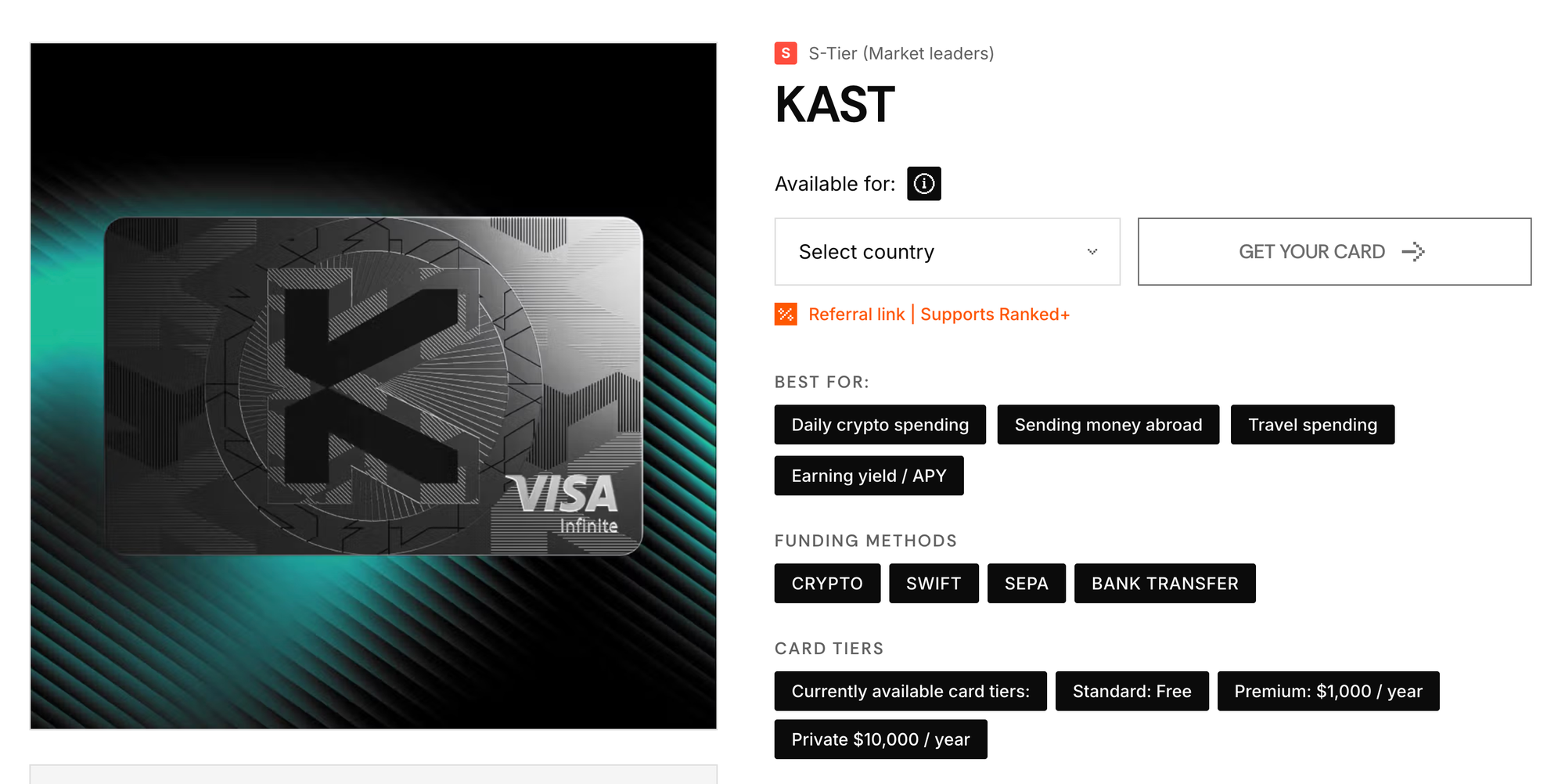
Based on our data, KAST is issued by Rain, runs on Visa, supports both virtual and physical cards, and allows funding through crypto, SWIFT, SEPA, and bank transfer. Our data also lists full KYC as required and shows cashback paid in USDC.
KAST’s official pricing and membership pages line up with the broad structure in our data: Standard is free, Premium is $1,000 per year, and Private is $10,000 per year. The official site also lists Standard as a Visa Platinum card, while Premium and Private are Visa Infinite tiers.
For rewards, KAST’s site shows:
- Standard: 1.5% cashback
- Premium: 2% cashback
- Private: 3% cashback
Is KAST a crypto card or a debit card?
KAST is best described as a crypto card with debit-style spending functionality.
Why that distinction matters:
- It is funded through crypto and account balances rather than a credit line.
- Stablecoin deposits are converted to a USD balance at 1:1 with 0% spread when funds enter the account.
- The product is tied to card transactions, bank transfers, and wallet-style functionality rather than revolving credit.
So if you are searching for a KAST debit card, the closest accurate description is: a Visa crypto spending card that behaves more like a prepaid or debit-style card than a credit card.
KAST card fees
KAST is not a no-fee card. The free tier removes the annual membership charge, but there are still FX, ATM, and some low-value transaction fees to consider.
| Card | Fee type | Amount | Notes |
|---|---|---|---|
| KAST | Annual fee | $0 to $10,000/year | By tier |
| KAST | FX fee | 0.5% to 1.75% | Non-USD spend |
| KAST | ATM fee | $3 + 2% | Per withdrawal |
| KAST | Top-up fee | 0% | Official help center |
Annual and card issuance costs
KAST’s fee page lists these annual membership prices:
- Standard: $0
- Premium: $1,000 per year
- Private: $10,000 per year
For card issuance:
- Standard includes the first two virtual cards free
- Additional virtual cards are $2 each
- In some countries, the first virtual card costs $2
- Standard physical cards are listed as free with a $40 shipping fee
That means the free plan is not always fully free in practice, especially if you want a shipped physical card.
KAST FX fees
KAST’s official fee page lists a 0.5% to 1.75% foreign exchange fee for non-USD card transactions, and says the exact fee depends on your country of residence and the country where the transaction happens.
This is one of the more important charges to check if you plan to use KAST for travel or day-to-day spending outside USD.
ATM fees and limits
KAST’s official help center lists these ATM terms:
- USD ATM withdrawals: $3 flat fee + 2%
- Non-USD ATM withdrawals: $3 flat fee + 2%, plus a 0.5% to 1.75% FX fee
- Limit: up to $250 per withdrawal
- 24-hour cap: 3 withdrawals or $750 total
For light ATM use, that may be acceptable. For frequent cash withdrawals, it is expensive.
Small transaction and declined transaction fees
KAST also lists:
- $0.10 for non-USD transactions under $25
- $0.50 for declined transactions caused by insufficient balance
These are not major headline fees, but they are easy to miss.
Supported countries and availability
Availability is where KAST needs the most careful reading.
KAST’s terms say the company may not offer services in all markets, can restrict certain jurisdictions, and determines access through the in-app country list shown during KYC. If your country is not listed in the app, KAST is not available there. The terms also say the list can change without notice.
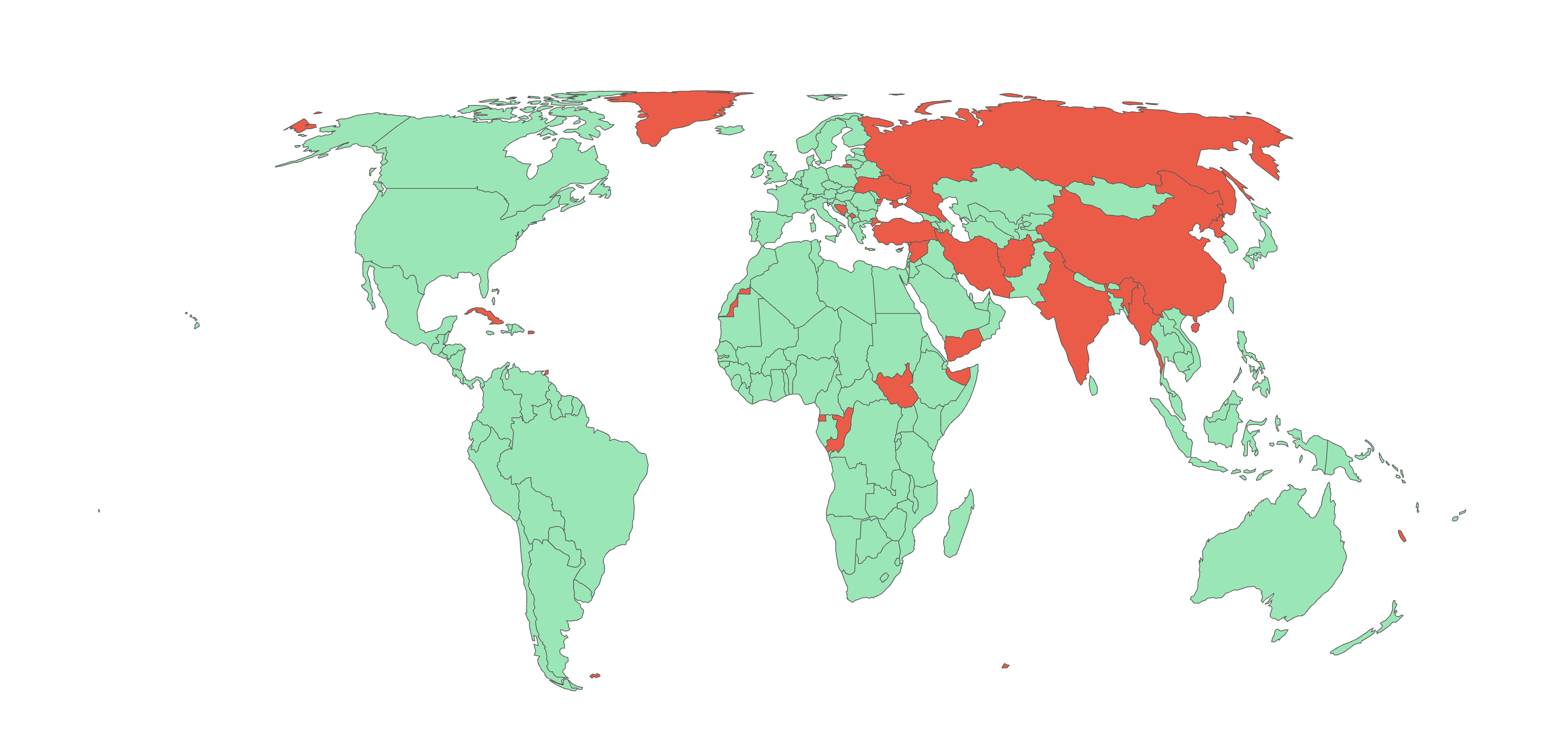
Based on our data, KAST supports a long list of countries across Europe, Latin America, the Middle East, Africa, Asia-Pacific, North America, and the UK. Our data also lists these excluded countries:
- Russia
- Ukraine
- North Korea
- Myanmar
- Iran
- Syria
- Cuba
- South Sudan
- Yemen
- China
- Afghanistan
Important country caveat
Because KAST does not publish a simple public master list and instead handles access dynamically during KYC, availability should be confirmed directly in-app before relying on it. KAST’s own terms support this general point: country eligibility is determined through the app’s supported-country list and can change over time.
The same caution applies to readers in the EU, EEA, APAC, GCC, LATAM, and MENA. Our data shows country-level support, but regional flags are not consistently broad-based. In other words, check your exact country rather than assuming a region-wide rollout.
Virtual card and physical card support
KAST supports both card formats.
| Card | Virtual card | Physical card | Wallet support |
|---|---|---|---|
| KAST | Yes | Yes | Apple Pay, Google Pay |
KAST’s official fee page confirms:
- virtual cards are available,
- physical cards are available,
- users may hold up to 10 cards in total,
- and Premium/Private virtual + physical versions are treated as one card for that limit.
This matters because many crypto card products are strong on virtual issuance but weaker on physical fulfillment. KAST appears to support both.
Funding methods and crypto functionality
KAST is built around stablecoin spending, but it also connects to fiat rails.
Based on our data, the main funding methods are:
- crypto
- SWIFT
- SEPA
- bank transfer
Official sources add more detail. KAST says users can receive ACH, SEPA, and wire transfers, and its terms define accepted tokens for deposit as USDT and USDC, while the fee page lists stablecoin withdrawals on Solana, Arbitrum, Ethereum, and Tron.
For many users, this is the main appeal of the KAST crypto card: it combines card spending with basic movement between stablecoins and bank rails.
Stablecoin withdrawals
KAST’s fee page lists these stablecoin withdrawal routes:
- Solana: USDT, USDC
- Arbitrum: USDC
- Ethereum (ERC-20): USDT, USDC
- Tron: USDT
It also lists:
- Minimum stablecoin withdrawal: $5
- Maximum stablecoin withdrawal: Unlimited
Cashback, rewards, and yield
KAST’s rewards setup is one of its stronger selling points.
| Card | Base cashback | Max cashback | Savings APY |
|---|---|---|---|
| KAST | 1.5% | 3% | 3% to 5.5% |
Based on our data, KAST offers:
- 1.5% base cashback
- up to 3% cashback by tier
- 3% to 5.5% savings APY
- yield sourced from RWA
KAST’s homepage broadly supports the tiered cashback model and advertises up to 3% cashback on memberships and up to 7% APY on earn products.
A few practical notes:
- The free Standard tier is the easiest way to access cashback.
- The paid tiers only make sense if your spending is high enough to justify the annual fee.
- If you care about payout currency, our data says cashback is paid in USDC.
KYC, residency, and compliance checks
KAST requires full KYC based on our data, and its terms say identity verification and screening may be required to access services. The company also says additional information may be requested on an ongoing basis, depending on AML and partner requirements.
That has two practical implications:
- Availability is not just country-based. Passing KYC is part of the access decision.
- Access can change. KAST’s terms say it may refuse, suspend, or close accounts, and may restrict services for legal, partner, or internal risk reasons.
If you plan to keep meaningful balances on the platform, that is worth understanding before signup.
Limits and restrictions to know
A few KAST restrictions stand out from the official documents:
- ATM withdrawals are capped at $250 per withdrawal and $750 per 24 hours.
- Users can hold up to 10 cards in total.
- Country access is tied to the supported-country list inside the app.
- KAST’s terms say users must not be located in, or nationals or residents of, restricted locations or embargoed countries.
There is also one data point that needs cautious interpretation: our data lists KAST as non-custodial, while KAST’s terms refer to a custodian wallet and partner-managed service structure. Readers who care about custody model should verify the current setup directly in KAST’s latest legal and support documents before treating it as a core reason to sign up.
Pros and cons
Pros
- Free entry tier available
- Both virtual and physical cards supported
- Apple Pay and Google Pay supported
- Stablecoin deposits and multi-network withdrawals supported
- Cashback available even on the Standard tier
- Bank transfer rails add flexibility beyond simple card spending
Cons
- Non-USD spending carries a 0.5% to 1.75% FX fee
- ATM use is relatively expensive
- Physical card shipping is not fully free on the Standard tier
- Country access is not presented as a clean public whitelist, so availability can be harder to confirm in advance
- The US availability signal in our data is mixed and should be checked carefully before applying
Who the KAST card is best for
KAST may be a better fit for:
- Stablecoin users who want to spend from a crypto-linked balance
- Frequent travelers who value global card acceptance and mobile wallet support, but can tolerate FX fees
- Remote workers and globally paid users who want account-style rails plus card spending
- Users who want rewards on spend without needing a conventional bank credit card
It may be a weaker fit for:
- Users who rely on cash withdrawals often
- People who need certainty on country support before signup
- Users who want a clearly documented no-fee FX card
- Anyone choosing purely on free-tier economics, since shipping and some transaction costs still apply
Final verdict
KAST is one of the more interesting crypto card products for users who want a stablecoin-first spending setup rather than a simple exchange-branded card. The strongest parts of the offer are the virtual and physical card support, Visa acceptance, mobile wallet integration, bank-transfer connectivity, and built-in rewards.
The weaker parts are also clear: FX fees on non-USD spending, costly ATM usage, and jurisdiction-specific availability that is not always easy to verify from public pages alone.
If your main goal is to spend USDC or USDT through a global Visa card, KAST looks competitive. If your main goal is cheap international FX or regular ATM access, the fee structure is less attractive.


