

Tria Card Review: Fees, Availability, and Crypto Card Features
A practical Tria card review covering fees, supported countries, rewards, KYC, card tiers, and crypto funding. See whether the Tria crypto card makes sense for spending stablecoins and other digital assets.
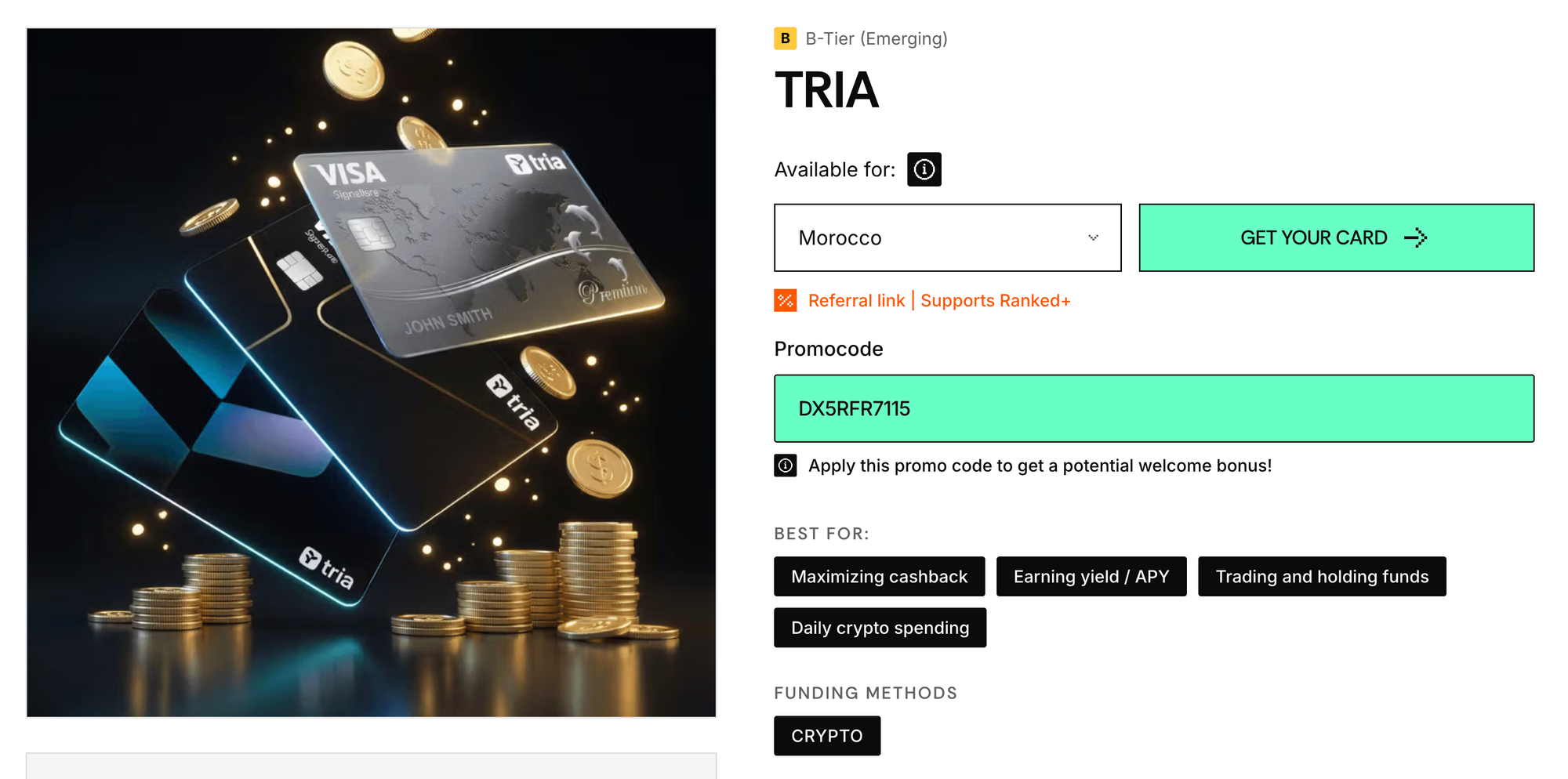
The Tria card is a crypto card built around a non-custodial wallet, crypto funding, and Visa spending. On paper, that makes it more flexible than a simple exchange-linked card. In practice, the main questions are more mundane: where it is available, what it costs, how funding works, and whether the real-world card experience justifies the annual fee.
This review focuses on those practical points. The short version is that Tria looks most useful for existing crypto users who already hold stablecoins or other assets on supported networks and want a virtual-first spending card. It looks less convincing as a primary spending account, a cash-replacement tool, or a place to keep large balances for everyday use.
Tria at a glance
- The Tria is an active crypto card with Visa network support.
- It is listed in our data as non-custodial at the wallet level.
- It supports virtual and physical cards.
- It works with Apple Pay and Google Pay.
- Funding method is crypto.
- KYC is full, and the fee is charged before KYC is completed.
- Availability is broad globally, but US access is unclear and restricted.
| Card | Type | Network | KYC |
|---|---|---|---|
| Tria | Crypto card | Visa | Full |
What the Tria crypto card is
Tria combines three functions in one product:
- A wallet layer for holding and moving crypto.
- A card funding layer that turns supported crypto into spendable card balance.
- A Visa payment layer for online, in-store, and mobile-wallet transactions.
That combination is the main reason the card is interesting. It reduces some of the usual friction between holding crypto and spending it. A user does not necessarily need to move funds through a separate centralized exchange just to make a card payment.
There is still an important caveat. While the wallet side is positioned as non-custodial, the card itself is still a regulated card product with an issuer, compliance controls, transaction approval rules, and program-level restrictions. In other words, this is best understood as a hybrid crypto payment product, not as pure direct on-chain merchant spending.
Who Tria may suit
Tria may be a fit for users who:
- already hold USDC or USDT and want to spend from crypto more directly;
- use multiple chains and want fewer manual steps before card spending;
- prefer a virtual card first, with Apple Pay or Google Pay support;
- want cashback in stablecoins rather than in a project token.
It may be a weaker fit for users who:
- want a bank-account replacement;
- need reliable local-fiat features like direct debit or salary receipt;
- plan to use the card heavily for ATM withdrawals;
- are unsure about country eligibility and do not want to pay before KYC.
Availability and supported countries
Availability is one of the most important parts of any crypto card review, and this is where Tria needs careful reading.
Our data marks Tria as broadly available globally, with a long supported-country list across Europe, Latin America, parts of Asia, Africa, the Middle East, and Oceania. At the same time, the data also flags a conflict around the United States:
| Card | Available globally | Available in US |
|---|---|---|
| Tria | Yes | No |
The same dataset also includes the United States in the supported countries list and notes that US availability may exist with state-level restrictions that are not published clearly. That means US eligibility should be treated as needs confirmation before payment.
A few examples of countries included in our data are:
- United Kingdom
- Canada
- Australia
- Germany
- United Arab Emirates
- Singapore
- Japan
- Brazil
- Mexico
 Editorial team
A few excluded countries in our data include:
- Russia
- Turkey
- India
- Vietnam
- Israel
- Ukraine
- Venezuela
- Zimbabwe
The practical takeaway is simple: Tria has wide coverage, but not cleanly explained coverage. If you are in the US or another restricted market, confirm the live program before paying for any tier.
Card types, tiers, and rewards
Tria offers a virtual tier and two physical-card tiers. The physical versions are split between plastic and metal.
| Card | Card format | Annual fee |
|---|---|---|
| Tria Virtual | Virtual only | $25 |
| Tria Signature | Plastic + virtual | $109 |
| Tria Premium | Metal + virtual | $250 |
Cashback starts at 1.5% and can reach 6%, depending on tier and reward structure.
| Card | Base cashback | Max cashback |
|---|---|---|
| Tria | 1.5% | 6% |
A few points matter here:
- Cashback is paid in USDC according to our data.
- Base cashback does not require staking.
- Optional TRIA token staking may unlock additional cashback.
- Cashback should not be treated as pure upside without checking exclusions, caps, or payout timing.
For many users, the Virtual tier is the most sensible starting point. It is the cheapest way to test merchant acceptance, mobile-wallet support, and real conversion cost before committing to a physical tier.
 Editorial team
Tria card fees
Fees are where crypto cards often look better in headline marketing than they do in real usage. Tria is no exception.
| Card | Annual / monthly fee | FX fee | ATM withdrawal fee |
|---|---|---|---|
| Tria | $0 monthly; $25–$250 yearly | 1% field; up to 3% noted | 3% |
Our data also includes these fee notes for Tria:
- Virtual: $25 per year
- Signature: $109 per year
- Premium: $250 per year
- Foreign exchange: numeric field shows 1%, while fee notes also mention up to 3%
- International transactions: up to 1%
- ATM balance inquiry: up to $2
- ATM decline: up to $2
- ATM withdrawal: up to $2 + 3%
This is one of the most important caveats in the whole review. The fee fields are not perfectly aligned. The simplest way to read them is:
- assume the lowest published number is not the worst-case cost;
- treat FX and international charges as variable;
- check the live fee preview before funding or spending.
For day-to-day use, stablecoin funding is likely the cleanest test case. If a user funds the card with more volatile assets, the true cost can include spread, slippage, and tax complexity in addition to published card fees.
 Editorial team
Crypto funding and supported networks
Tria is crypto-funded rather than fiat-funded. That matters because the user experience depends less on traditional bank rails and more on supported networks, top-up minimums, and conversion quality.
Our data and the supporting product notes indicate support for card top-ups from networks including:
- Bitcoin
- Ethereum
- Polygon
- Base
- Arbitrum
- Optimism
- BNB Chain
- Aptos
- Solana
There are also practical limits:
- Bitcoin top-up minimum: $50
- Most other documented network minimums: $10
- Virtual card funding: crypto only
- Direct SOL top-ups for card balance: may require supported tokens rather than native SOL
- Avalanche: not currently supported for top-ups in the reviewed material
This is where Tria’s strongest use case becomes clearer. It is more compelling for a user already moving funds across chains than for someone who just wants a simple fiat spending card.
KYC, residency, and onboarding
Tria requires full KYC, and the onboarding flow is stricter than the marketing summary might suggest.
| Card | KYC | Issuer | Key onboarding note |
|---|---|---|---|
| Tria | Full | Nimbus LLC | Fee charged before KYC |
According to our data, onboarding requires:
- ID document
- residential address
- phone number
All three must match the same country. KYC can only be completed in supported countries.
This matters because Tria charges the fee upfront before KYC, and the fee is listed in our data as non-refundable if rejected. That is a meaningful operational risk, especially for users in countries with unclear eligibility or state-level restrictions.
Users should also expect country-matching checks, document validation, and standard compliance screening. If your residency status is not straightforward, this is not a product to buy first and sort out later.
Virtual card, physical card, and ATM support
Tria supports both virtual and physical cards, but the virtual card is the more practical part of the offer.
| Card | Virtual card | Physical card | Mobile wallets |
|---|---|---|---|
| Tria | Yes | Yes | Apple Pay, Google Pay |
A few practical notes:
- Virtual tier: digital-only and the easiest way to test the card.
- Signature tier: plastic physical card plus virtual card.
- Premium tier: metal physical card plus virtual card.
- Apple Pay and Google Pay: supported in our data.
- ATM access: no access on Virtual; available on higher tiers.
ATM limits are not especially strong:
- Virtual: $0
- Signature: $750 per day, fee applies
- Premium: $750 per day free
That structure makes Tria better as a digital spending card than as a cash-access card.
 Editorial team
Savings, yield, and extra crypto features
Tria is not only a card product. Our data also lists broader crypto features tied to the platform:
- spot trading
- crypto futures
- futures on commodities
- futures on stocks
- DeFi-linked yield sources
- savings APY range of 3% to 13%
Those features may appeal to crypto-native users, but they also make the product more complex. For a user who only wants a spending card, the extra trading and yield layers are not automatically a benefit. More features can mean more moving parts, more risk surface, and more reason to keep only limited spending balances in the app.
Main strengths and limitations
What looks strong
- Wide country coverage: the supported-country list is broad.
- Virtual-first usability: useful for online spending and mobile wallets.
- Non-custodial wallet angle: appealing for users who do not want a fully custodial setup.
- Stablecoin cashback: more attractive than rewards paid in a volatile native token.
- Multi-chain funding: useful for active crypto users.
What needs caution
- US availability is unclear: the data contains a direct conflict.
- Fee presentation is mixed: 1% and up to 3% FX references both appear.
- Pay-before-KYC flow: a rejected applicant may still lose the upfront fee.
- ATM economics are weak: not a core reason to choose the card.
- Real conversion cost matters more than headline cashback: spread can matter more than the reward rate.
- Complexity: this is still a maturing crypto payment product, not a simple bank card.
Tria review verdict
For the right user, Tria solves a real problem. It gives crypto-native users a way to move from wallet balances to Visa spending without relying entirely on a centralized exchange withdrawal flow. That is useful, especially if the user already keeps funds on networks like Base, Arbitrum, Optimism, Ethereum, or Solana and mainly wants a virtual card for online and mobile-wallet spending.
The more cautious view is that Tria should still be treated as a secondary crypto-spend card, not as the foundation of a personal banking setup. The strongest concerns are not abstract. They are practical: unclear US availability, pre-KYC payment, mixed fee disclosures, and the usual question of whether a foreign-issued card works smoothly at local merchants.
Tria may be worth testing for users who want a crypto-funded Visa card with virtual access, cross-chain funding, and stablecoin cashback. The Virtual tier is the lowest-risk way to do that. It gives a user a cheaper route to test real spend behavior, transaction acceptance, and the all-in cost of converting crypto into card usage.
The more expensive tiers only make sense if the card works reliably in the user’s country and the effective cashback outweighs the annual fee. For many users, that will need real testing rather than assumptions.


