

Best Crypto Cards in Nigeria: Availability, Fees, and Supported Cards
Compare crypto cards relevant to Nigeria by availability status, fees, virtual and physical card support, funding methods, and key caveats. This guide focuses on practical card access for Nigerian residents.
For Nigerian residents, the main appeal of a crypto card is usually simple: turning USDT or USDC into a usable card for international online payments, subscriptions, travel bookings, and some contactless purchases. That is different from replacing a local bank account, naira debit card, or ATM cash access.
The practical question is not how many crypto cards exist globally. It is which ones are relevant to Nigerian users, what they cost, and which ones need extra availability checks before funding.
Quick answer
Based on our data, the strongest starting points for Nigeria are:
- Hawala – simple virtual card setup, low headline fees, and a Nigeria-focused use case.
- COCA – broad funding support, virtual and physical cards, and a multi-chain setup.
- Bitget Wallet Card – a practical fit for users already holding funds inside Bitget.
- RedotPay – one of the most established crypto-to-card workflows in the group.
- Tria, EtherFi Cash, Kolo, Lava Card, and Oobit – interesting on paper, but Nigerian users should confirm live eligibility in-app before depositing funds.
Two extra caution flags matter here:
- Jam Card may work for some users, but it is harder to recommend for routine spending because cost clarity is weaker.
- KAST and Wirex appear in our database, but Nigerian card availability should be verified carefully before treating them as active local options.
 Editorial team
Why crypto cards matter in Nigeria
Nigeria is one of the markets where crypto cards can solve a real payment problem, especially for international digital spending.
The common use case looks like this:
- Convert naira into USDT or USDC.
- Fund a crypto card account or wallet.
- Spend through Visa or Mastercard at an online merchant.
That model can help with:
- software subscriptions,
- cloud services,
- streaming platforms,
- travel bookings,
- online purchases from foreign merchants.
It is less reliable for:
- day-to-day naira spending,
- ATM withdrawals,
- merchants that reject foreign-issued cards,
- situations where billing-address matching is strict.
Which crypto cards are relevant to Nigeria?
The cards below are the main Nigeria-related shortlist in our data.
| Card | Status | Virtual | Physical |
|---|---|---|---|
| Bitget Wallet Card | Active | Yes | Yes |
| COCA | Active | Yes | Yes |
| EtherFi Cash | Active | Yes | Yes |
| Hawala | Active | Yes | No |
| Jam Card | Active | Yes | No |
| KAST | Active | Yes | Yes |
| Kolo | Active | Yes | No |
| Lava Card | Active | Yes | Yes |
| Oobit | Active | Yes | No |
| RedotPay | Active | Yes | Yes |
| Tria | Active | Yes | Yes |
| Wirex | Active | Yes | Yes |
Nigeria availability: what is confirmed and what still needs checking
A card being globally active is not the same thing as confirmed Nigerian issuance. For this market, it helps to separate cards into three groups.
More practical starting options
These are the cards that look most usable for Nigerian residents based on our data and the current public picture:
 Editorial team
Cards that may work, but need live onboarding confirmation
These cards have useful features, but Nigerian users should verify country selection, KYC acceptance, and card issuance inside the app before depositing funds:
 Editorial team
Cards that need extra caution on Nigeria card availability
These appear in our database, but current Nigerian card support should be checked especially carefully:
 Editorial team
Quick comparison: fees and funding
| Card | Funding | FX fee | Monthly fee |
|---|---|---|---|
| Hawala | Crypto, SWIFT, SEPA, ACH | 3% | 0 |
| COCA | Crypto, bank transfer, SEPA | 0% | 0 |
| Bitget Wallet Card | Crypto | 1% | 0 |
| RedotPay | Crypto, bank transfer | 1% | 0 |
| Tria | Crypto | 1% | 0 |
| EtherFi Cash | Crypto, bank rails | 0% | 0 |
This is only the headline card-level view. Real cost can still include:
- spread when buying USDT or USDC,
- withdrawal or network fees,
- stablecoin conversion,
- Visa or issuer FX treatment,
- merchant-side currency conversion.
Best crypto cards in Nigeria by use case
| Use case | Best fit | Why |
|---|---|---|
| Online USD spending | Hawala | Simple virtual setup |
| Multi-chain spending | COCA | Broad funding support |
| Exchange-linked spending | Bitget Wallet Card | Good for Bitget users |
| Established fallback | RedotPay | Familiar card workflow |
Card-by-card breakdown
Hawala
Hawala is one of the clearest fits for Nigerian users who mainly want a virtual crypto card for international online payments. In our data, it supports a virtual Visa card, uses a custodial model, and allows funding through crypto plus selected bank rails. It has no physical card in this dataset.
The main attraction is simplicity. If your goal is stablecoin-funded online spending rather than a feature-rich rewards product, Hawala is easy to understand. The trade-off is that it is more limited than some multi-chain competitors, and Nigerian users should still test small transactions first before relying on it for recurring billing.
COCA
COCA is one of the strongest all-around options in this group. It combines virtual and physical card support with a non-custodial model, crypto funding, bank transfer options, and a 0% FX fee in our data. It also lists 0% ATM withdrawal fee and a 5% savings APY.
For Nigerian users, the main advantage is flexibility. COCA is a better fit than a simple single-rail card if you already move funds across different wallets, networks, or funding methods. The main thing to confirm before heavy use is the exact cost of conversions and the practical experience of physical card ordering from Nigeria.
Bitget Wallet Card
Bitget Wallet Card is most relevant to users who already hold spendable balances in the Bitget ecosystem. In our data, it supports both virtual and physical cards, uses a custodial setup, and charges 1% FX fee with a 2% ATM fee.
Its biggest strength is convenience for exchange-linked spending. If you are already operating inside Bitget, the flow from crypto balance to card spending is straightforward. The trade-off is that it is less compelling if most of your real-world spending is in non-USD currencies or outside the exchange workflow.
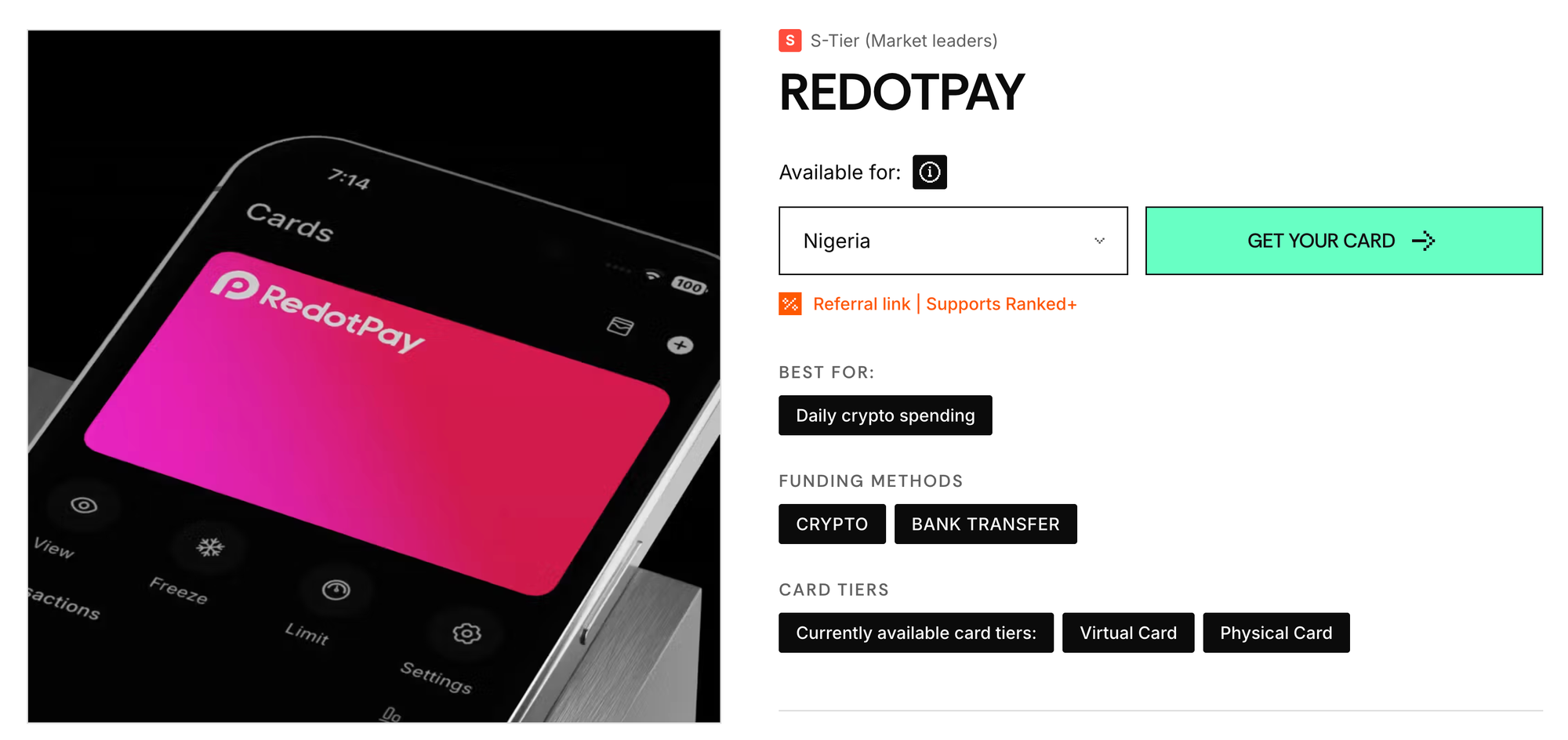
RedotPay
RedotPay is one of the better-known names in crypto card spending and has the strongest adoption signal in this Nigeria-related group in our data. It supports virtual and physical cards, uses a custodial model, and lists 1% FX fee with 2% ATM withdrawal fee.
For Nigerian users, RedotPay is best seen as a practical fallback option. It may suit users who care more about a familiar crypto-to-card flow than a non-custodial setup. The main caution is cost discipline: headline monthly fees are low, but conversion and usage costs still matter.
Tria
Tria combines virtual and physical cards with a non-custodial model. In our data, it supports crypto funding, lists 1% FX fee and 3% ATM withdrawal fee, and shows one of the higher APY ranges in the shortlist.
That makes it interesting for users who want more than a simple spending card. Still, Nigerian residents should treat it as a confirm-first product. Country eligibility, KYC acceptance, and live issuance should all be checked before paying fees or sending funds.
EtherFi Cash
EtherFi Cash has one of the broader feature sets in the list. It supports virtual and physical cards, a non-custodial model, crypto funding plus several bank rails, 0% FX fee, 2% ATM fee, 3% cashback, and 2% to 8% savings APY in our data.
For Nigerian users, the appeal is obvious if you already operate inside DeFi or want a higher-feature wallet-and-card product. The trade-off is that it is not a Nigeria-first card, so onboarding and eligibility should be checked in real time rather than assumed.
Cards worth checking, but not top picks
These cards may still be relevant for some Nigerian users, but they are not the strongest default starting points in this group:
- Kolo – virtual-only, custodial, 0% FX fee in our data, but local usability should be confirmed.
- Lava Card – virtual and physical support, 0% FX and 0% ATM in our data, but Nigeria onboarding should be checked directly.
- Oobit – virtual-only with variable cashback, but practical card availability should be confirmed.
- Jam Card – virtual-only, non-custodial, Mastercard network, but weaker cost clarity for routine use.
- KAST – strong feature set in our data, but Nigerian card availability needs verification before use.
- Wirex – broad feature set in our data, but Nigerian card issuance should be checked carefully.
 Editorial team
Top-5 cards by cashback
| Card | Base cashback | Max cashback | Cashback paid in |
|---|---|---|---|
| Bitget Wallet Card | 10% | 20% | BGB |
| Oobit | 0% | 10% | USDT |
| COCA | 1% | 8% | USD or EUR |
| Wirex | 0.5% | 8% | WXT |
| Tria | 1.5% | 6% | USDC |
Top-5 cards by savings APY
| Card | APY from | APY to |
|---|---|---|
| Wirex | 1% | 16% |
| Tria | 3% | 13% |
| EtherFi Cash | 2% | 8% |
| Lava Card | 6.5% | Needs confirmation |
| KAST | 3% | 5.5% |
Top-5 cards by fees
| Card | Monthly fee | FX fee | ATM fee |
|---|---|---|---|
| COCA | 0 | 0% | 0% |
| Lava Card | 0 | 0% | 0% |
| Wirex | 0 | 0% | 0% |
| EtherFi Cash | 0 | 0% | 2% |
| Kolo | 0 | 0% | Needs confirmation |
Top-5 cards by adoption
| Card | Users signal | Volume signal |
|---|---|---|
| RedotPay | 500K–1M users | $5B–$10B total volume |
| KAST | 100K–250K users | $1B–$2B total volume |
| EtherFi Cash | 75K–100K users | $1B–$2B total volume |
| Wirex | 75K–100K users | $500M–$750M total volume |
| Bitget Wallet Card | 75K–100K users | $30M–$75M total volume |
What Nigerian users should check before funding any card
1. Live country selection
Do not assume that a card is issuable in Nigeria just because the product is globally active. Confirm that Nigeria appears in onboarding and that KYC accepts Nigerian documents.
2. Card type
A virtual card is enough for subscriptions and many online purchases. It is usually not enough for ATM access or merchants that insist on a physical card.
3. Stablecoin and network precision
Some cards are straightforward only if you send the exact supported asset on the exact supported network. If a provider expects one stablecoin route, sending the wrong token or chain can create delays or losses.
4. Real total cost
The relevant question is not only whether monthly fee is zero. It is the full cost from naira conversion to final merchant settlement.
5. Merchant acceptance
Foreign-issued virtual cards can still fail at local gateways, recurring billing checks, or billing-address verification.
 Editorial team
A low-risk testing process
Before relying on any crypto card in Nigeria, a simple test flow is safer:
- Confirm Nigeria is selectable in onboarding.
- Complete KYC with real details only.
- Start with a virtual card if available.
- Fund a small amount first.
- Test one international online payment.
- Test one smaller local purchase if relevant.
- Record the full cost from deposit to settlement.
- Keep only a spending balance, not savings.


