

RedotPay Card Review: Fees, Countries, and Virtual Crypto Card Features
A fact-based RedotPay card review covering virtual and physical card availability, fees, supported countries, KYC, funding methods, and key limitations. See whether the RedotPay crypto card is available in your country and what to check before signing up.

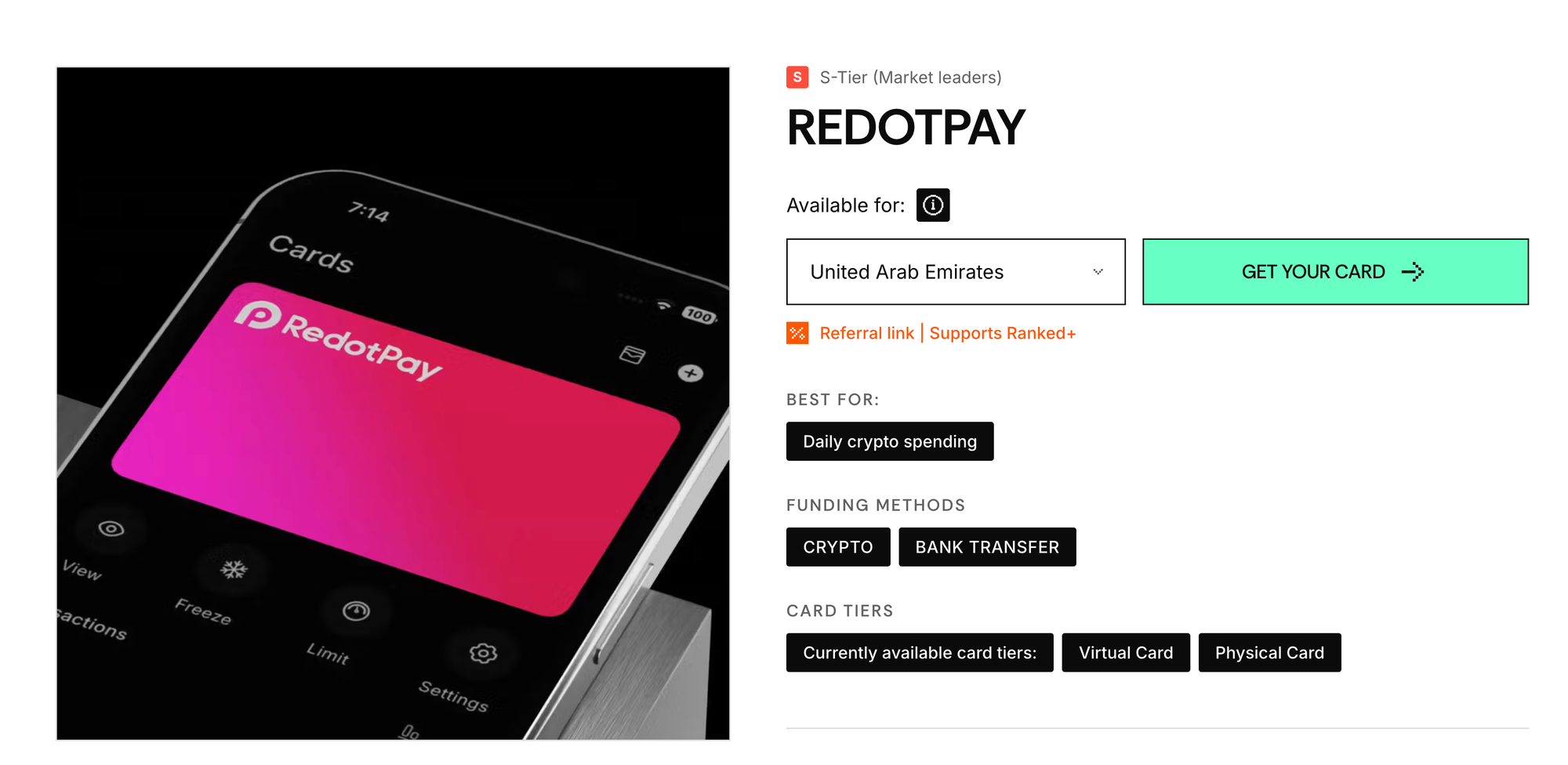
The RedotPay card is a custodial Visa crypto card that lets users fund spending with crypto and use either a virtual card or physical card for everyday payments. Based on our data, it is positioned for daily crypto spending, supports Apple Pay and Google Pay, has no monthly or annual fee, and is available in many countries outside the United States.
RedotPay says its card can be used at 130M+ merchants worldwide, and its official card page highlights both instant-use virtual cards and physical cards with ATM access.
For most readers, the real questions are simple:
- Is RedotPay available in my country?
- Is there a RedotPay virtual card?
- What does the card actually cost to use?
- Is it a good fit for daily spending, or only for niche crypto use?
This review focuses on those practical points.
RedotPay card at a glance
| Card | Network | Card types | Custody |
|---|---|---|---|
| RedotPay | Visa | Virtual, Physical | Custodial |
| Card | Monthly fee | FX / conversion fee | ATM fee |
|---|---|---|---|
| RedotPay | $0 | 1% | 2% |
| Card | Cashback | KYC | Available in US |
|---|---|---|---|
| RedotPay | 0% | Full | No |
Check up-to-date information about RedotPay on Ranked+ Cards.
To receive a welcome bonus of $5, make sure to apply the code: p61y3.
What is the RedotPay card?
RedotPay is a stablecoin-based payment app with card, wallet, transfer, credit, earn, and P2P features. Official RedotPay materials describe the card product as a way to spend crypto like cash, with both virtual and physical card options, mobile wallet support, and merchant acceptance across the Visa ecosystem. RedotPay’s help center also says the app converts supported crypto to local currency at the moment you pay, so users do not need to manually sell assets before each purchase.
In practical terms, this means the RedotPay crypto card is designed more like a spending tool than a passive rewards card. The value proposition is convenience and availability, not cashback.
Is there a RedotPay virtual card?
Yes. RedotPay officially offers a virtual card and a physical card. Its card page says virtual cards are designed for digital-first spending and that users can start spending “within minutes.” Its help center also explains that users apply for the virtual card in-app and pay a $10 issuance fee, which is non-refundable once paid.
That matters because “virtual card” is one of the strongest reasons people search for RedotPay in the first place. If you want a crypto card mainly for:
- online subscriptions,
- app payments,
- travel bookings,
- faster onboarding,
- Apple Pay or Google Pay use,
the virtual card is the main RedotPay product to look at first.
Is there a physical RedotPay card?
Yes. RedotPay also offers a physical card. Official materials say the physical card can be used for in-person spending and ATM withdrawals, and the help center lists a one-time $100 issuance fee for applying. That fee is also described as non-refundable once the application is submitted.
The physical card is more relevant if you need:
- cash withdrawals,
- a backup payment card for travel,
- point-of-sale use where a physical card works better than a mobile wallet.
The main drawback is obvious: $100 upfront is expensive for a physical crypto card unless you expect to use it regularly.
RedotPay supported countries
Based on our data, RedotPay is available across a long list of countries in Europe, Asia-Pacific, Latin America, the Middle East, Africa, Canada, and Hong Kong. It is not available in the United States.
Official RedotPay help-center documentation does not publish the same long supported-country list in the source we reviewed, but it does clearly publish an unsupported countries and regions list and says people from those jurisdictions cannot complete KYC or use RedotPay’s services. That official list includes the United States, Mainland China, Russia, Ukraine, Venezuela, Iran, Iraq, Syria, North Korea, and several other restricted jurisdictions. RedotPay also says those restrictions may change as regulations evolve.
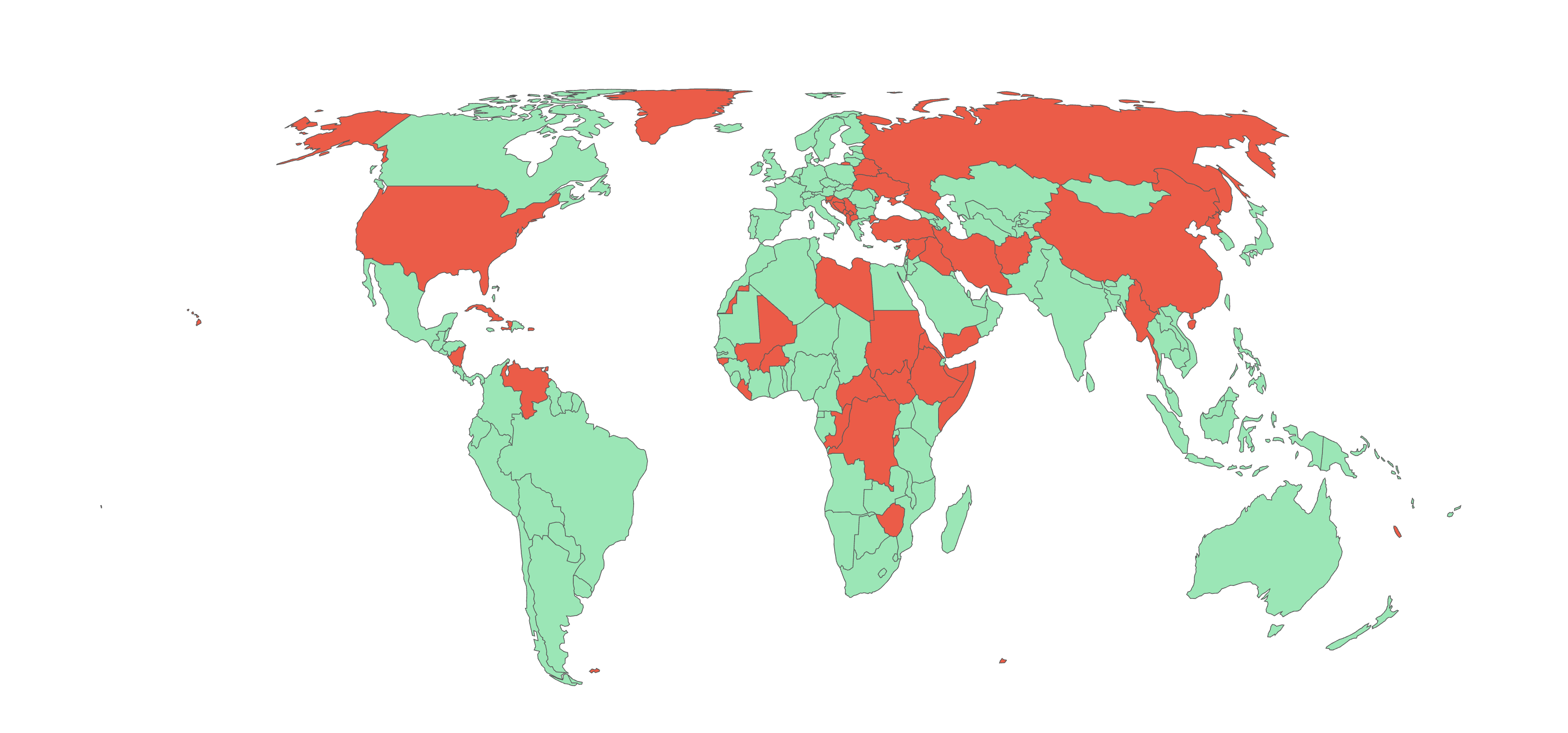
Countries where RedotPay is available in our data
The supported-country list in our data includes, among others:
Argentina, Australia, Austria, Bahrain, Bangladesh, Belgium, Brazil, Cambodia, Canada, Chile, Colombia, Czechia, Denmark, Egypt, France, Germany, Ghana, Greece, Hong Kong, Hungary, India, Indonesia, Ireland, Israel, Italy, Japan, Jordan, Kazakhstan, Kenya, Malaysia, Mexico, Morocco, Netherlands, New Zealand, Nigeria, Norway, Oman, Pakistan, Panama, Peru, Philippines, Poland, Portugal, Qatar, Romania, Saudi Arabia, Singapore, South Africa, South Korea, Spain, Sri Lanka, Sweden, Switzerland, Taiwan, Thailand, Turkey, United Arab Emirates, United Kingdom, Uruguay, Vietnam, and Zambia.
Check RedotPay availability in your country on Ranked+ Cards!
RedotPay card fees
This is the area you should read most carefully.
Based on Ranked+ Cards data, the current headline fees are:
| Fee type | RedotPay |
|---|---|
| Monthly fee | $0 |
| Virtual card issuance | $10 |
| Physical card issuance | $100 |
| Crypto conversion / FX fee | 1% |
| Fee type | RedotPay |
|---|---|
| ATM withdrawal fee | 2% |
| ATM fee above $10,000/month | 3% |
| Cashback | 0% |
| Annual fee | $0 |
Official RedotPay help-center content confirms that the company charges no card management fees, monthly fees, or annual fees, and that virtual and physical card applications have separate one-time fees. Its fee article is the official source for card pricing, while the separate help article confirms the lack of monthly and annual card fees.
What the fee structure means in practice
The fee stack is not unusual for a crypto spending card, but it is not cheap either.
For light users, the biggest cost is usually the upfront issuance fee. For active users, the bigger issue is the 1% conversion cost plus any ATM fee. If your goal is simply to keep a spare virtual crypto card for occasional online spending, RedotPay may still be workable. If your goal is cheapest possible card spend, the fee structure is less attractive than cards that compete more aggressively on FX or cash rewards.
Funding methods and crypto support
Based on our data, RedotPay supports crypto and bank transfer funding methods.
Official help-center documentation also says users can:
- add crypto through on-chain deposits,
- buy crypto in the app,
- and then apply for a card once identity verification is complete.
For supported assets, RedotPay’s official help center lists major cryptocurrencies including:
- BTC
- ETH
- BNB
- SOL
- S
- SUI
- TRX
- XRP
- USDT
- USDC
Its deposits article also says supported cryptocurrencies and networks can change over time, and that deposits below the required minimum are not credited until the user tops up with another deposit of the same asset on the same network to reach the minimum.
Supported fiat and local currencies
For RedotPay’s P2P marketplace, the company says all verified users can trade USD and EUR, and that local currency options depend on the country used for identity verification. RedotPay’s help center says P2P supports 74 local currencies in total.
That does not mean every one of those currencies is a direct card base currency, but it does show that the broader RedotPay ecosystem is built for cross-border and local-currency use.
KYC and onboarding
RedotPay requires full KYC based on our data, and its official onboarding guide says users must:
- download the app,
- sign up,
- complete identity verification,
- add crypto or buy crypto,
- then apply for a virtual or physical card.
The virtual card application flow also requires a billing address in English, while the physical card requires both billing and shipping addresses in English. RedotPay says unsupported jurisdictions cannot use those addresses for card application.
So if you are evaluating RedotPay mainly for speed, the likely flow is:
- sign up,
- pass KYC,
- fund the account,
- pay the issuance fee,
- start using the virtual card.
Rewards, yield, and extras
Based on our data, the RedotPay card itself offers 0% cashback.
That is important because some readers assume every crypto card competes on rewards. RedotPay does not appear to be doing that here. The card is better understood as a utility product for crypto spending rather than a rewards maximizer.
RedotPay does have broader platform features beyond the card, including wallet, P2P, credit, and earn functions in official product materials. But those are separate from the card’s core reward profile.
Main strengths
1. Strong virtual-card proposition
The biggest strength is straightforward: RedotPay clearly supports a real virtual crypto card product, and official materials position it for fast digital spending with Apple Pay and Google Pay support.
2. Broad international availability
Based on our data, country coverage is wider than many region-locked card programs. Official RedotPay help materials also describe services as being available in over 100 countries.
3. Usable for both everyday spend and ATM access
The combination of virtual card, physical card, and physical-card ATM withdrawals makes it more versatile than cards that only work online.
4. No monthly or annual fee
RedotPay confirms there is no monthly, annual, or card management fee, which lowers the cost of keeping the card active.
Main limitations
1. The upfront card fees are high
A $10 virtual card fee is manageable, but a $100 physical card fee is a real barrier for casual users. Official help articles also say both application fees are non-refundable after submission.
2. No cashback
If your main goal is rewards, RedotPay is weak on that front based on our data.
3. Full custodial model
Based on our data, RedotPay is custodial. That may be fine for convenience-focused users, but it is still a trade-off for users who prefer self-custody.
4. Country restrictions still matter
The card is global, but it is not universal. The US is excluded, and RedotPay’s official unsupported-country list is extensive.
Who the RedotPay card may suit
The RedotPay card may be a reasonable fit for:
- users outside the US who want a virtual crypto card quickly,
- people who already hold USDT, USDC, BTC, ETH, or other supported assets,
- users who want a spending-focused card rather than a cashback card,
- travelers or international users who want a physical card with ATM support.
It may be less suitable for:
- US users,
- users who want non-custodial control,
- people mainly optimizing for cashback,
- anyone who wants the lowest possible upfront fee on a physical card.
Verdict
As a pure RedotPay card review, the product looks strongest on virtual card availability, broad country support, and practical spendability. It looks weaker on rewards and on the cost of getting the physical card.
If your priority is a RedotPay virtual card for online and mobile-wallet spending, the offer is relatively clear: full KYC, $10 issuance, no monthly fee, and broad non-US availability. If your priority is a physical crypto card with strong economics, the $100 issuance fee makes the decision harder.
Overall, RedotPay looks more like a global crypto spending tool than a rewards card. That makes it potentially useful – but only if the country support, KYC eligibility, and total fee picture work for your specific use case.
RedotPay
RedotPay is a custodial Visa crypto card with both virtual and physical options, global availability outside restricted jurisdictions, no monthly fee, and a fee structure centered on issuance, conversion, and ATM use. Its strongest use case is day-to-day crypto spending rather than cashback or premium rewards. Based on our data, it is best suited to users who value fast virtual-card access and broad international support.


