

Plasma One Card Review: Fees, Availability, and Crypto Card Features
This Plasma One card review covers fees, countries, rewards, KYC, app features, and key limitations. See how the Plasma One crypto card works before you sign up.
Plasma One is a crypto card product built around stablecoin spending, transfers, and optional yield inside one app. The main pitch is simple: hold a dollar-denominated stablecoin balance, create a virtual Visa card, add it to Apple Pay or Google Pay, and spend without pre-selling through a centralized exchange.
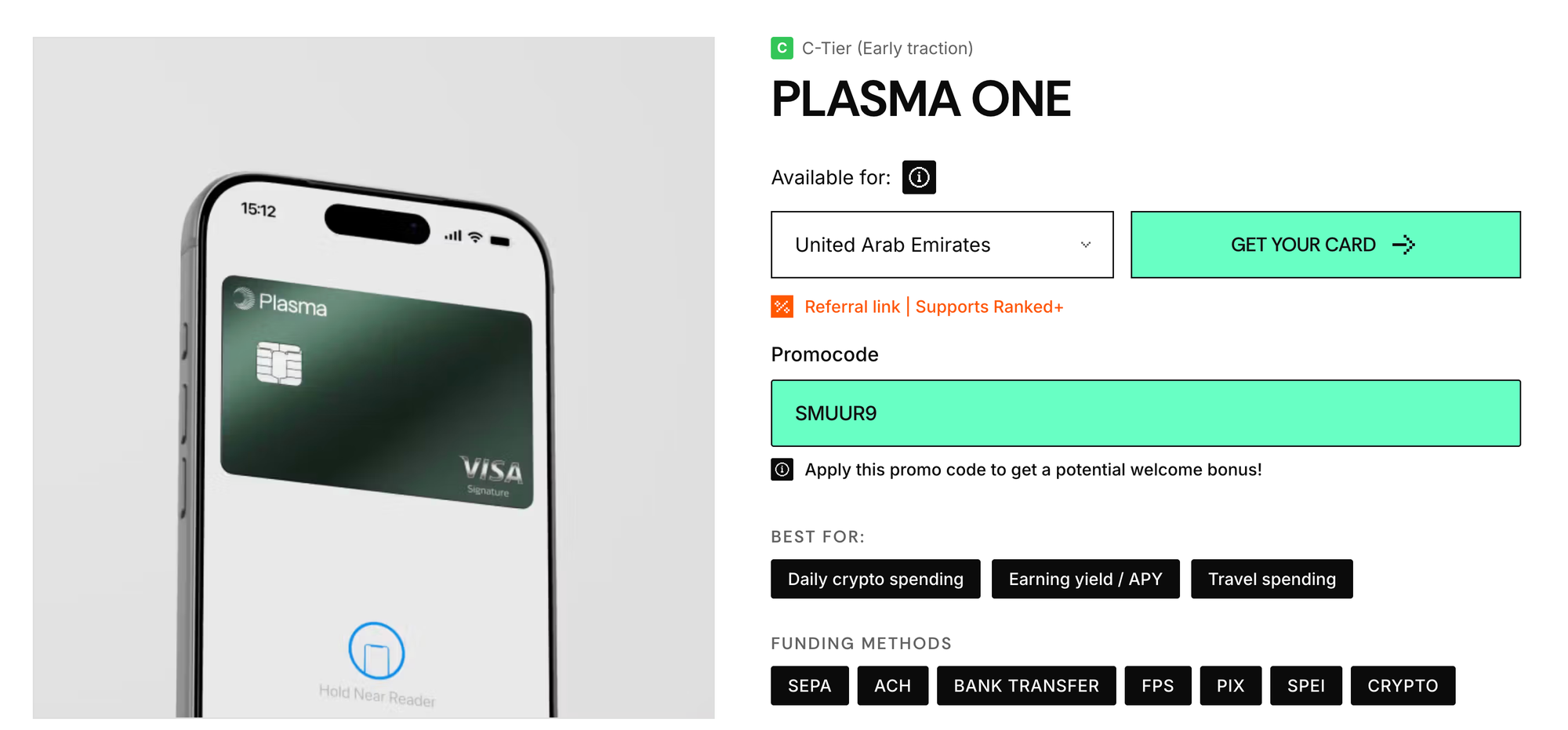
The product is interesting because it combines several things that are usually separate: a wallet, a spending card, cross-border transfers, and an Earn feature. The trade-off is that Plasma One still looks more like an early crypto neobank than a finished primary banking replacement.
For most users, the right question is not whether Plasma One is innovative. It is whether the card works reliably in their country, whether the fee structure is actually competitive after conversions and partner charges, and whether the rewards are worth the extra token and platform risk.
Quick answer
Plasma One may be a good fit for users who want a secondary stablecoin spending account with a virtual Visa card, mobile wallet support, cashback, and bank or crypto funding options. Based on our data, it supports virtual and physical cards, uses the Visa network, and is structured as a non-custodial crypto card with full KYC.
The main caveats are also clear:
- US availability is inconsistent across the available data
- ATM withdrawals are not supported
- Cashback is paid in XPL, so reward value is volatile
- Yield is variable and should not be treated like insured savings
- Country access and terms should be checked in-app before funding
Plasma One at a glance
Best for daily crypto spending, yield access, and travel spending
| Card | Type | Network | Custody |
|---|---|---|---|
| Plasma One | Crypto card | Visa | Non-custodial |
| Card | Virtual card | Physical card | Mobile wallets |
|---|---|---|---|
| Plasma One | Yes | Yes | Apple Pay, Google Pay |
What the Plasma One card is
Plasma One is a stablecoin spending app with a Visa card layer. In practice, that means users can fund the app through fiat rails or crypto, keep a stablecoin balance, and use that balance for card purchases.
This is not the same thing as a normal debit card linked to a bank account. Plasma One positions itself as a crypto-native spending product, and the legal structure matters. Marketing focuses on self-custody and user-controlled assets, but card use still depends on the card program, issuer relationships, compliance checks, and applicable card terms.
That distinction matters because a self-custody-style setup does not remove card-program risk. A card can still be declined, suspended, or restricted under issuer or compliance rules.
Who Plasma One may suit
Plasma One may be a better fit for:
- users who hold USDT or USDC and want to spend from a stablecoin balance
- users who want a virtual crypto card first and a physical card second
- cross-border users who value stablecoin transfers plus spending
- users who want Apple Pay or Google Pay support
- users who are comfortable with token-based cashback and optional DeFi yield
It may be a weaker fit for:
- anyone looking for a primary bank account
- users who need ATM cash withdrawals
- users who want fixed-value cashback
- users who do not want KYC
- users who plan to keep a large emergency balance inside a crypto card app
 Editorial team
Card features and app experience
Based on our data, Plasma One combines a card app and stablecoin account into one interface.
| Card | Funding methods | KYC | ATM withdrawals |
|---|---|---|---|
| Plasma One | SEPA, ACH, Bank transfer, FPS, PIX, SPEI, Crypto | Full | Not supported |
Key features include:
- Virtual Visa card
- Physical card
- Apple Pay and Google Pay
- Stablecoin funding
- Bank-transfer funding
- Cashback in XPL
- Yield on eligible balances
- In-app security controls
Supported funding rails in our data include SEPA, ACH, FPS, PIX, SPEI, bank transfer, and crypto. That is a useful mix for international users, although actual off-ramp and on-ramp availability can still vary by region.
The card’s strongest practical use case is everyday stablecoin spending. The broader app proposition is that users can move money in, hold a dollar-linked balance, spend it through Visa rails, and optionally earn yield on idle funds.
Fees: simple headline, but not zero total cost
Plasma One’s headline pricing is attractive, but users should separate card fees from total transaction cost.
| Card | Monthly / annual fee | FX fee | Cross-border fee |
|---|---|---|---|
| Plasma One | Minimum monthly fee: $0 | 1% on non-USD transactions | 0% |
| Card | ATM withdrawals | Notes | Review status |
|---|---|---|---|
| Plasma One | Not supported | Partner fees may still apply | Needs review |
Fee notes by tier
- Lite: free card, standard fees
- Core: our data says $120 per year or staking 20,000 XPL
- Platinum: our data says staking 150,000 XPL and no additional fees
The more practical way to judge fees is to compare four numbers on a real test transaction:
- the amount of stablecoin sent in
- the balance credited in the app
- the final merchant charge
- the amount deducted after settlement
That gives a more useful view than a “no additional fees” marketing line on its own.
 Editorial team
Rewards and yield
Plasma One offers both cashback and yield, but neither should be treated as risk-free.
| Card | Base cashback | Max cashback | Cashback paid in | Savings APY |
|---|---|---|---|---|
| Plasma One | 2% | 4% | XPL | 4% to 6% |
Because table width matters, the tier detail is easier to read separately:
| Tier | Base cashback | Extra perk | Key limit |
|---|---|---|---|
| Lite | 2% | Free card | Max $250/month |
| Core | 3% | 5% AI cashback | Needs confirmation |
| Platinum | 4% | 10% AI cashback | Max $1,000/month |
The key limitation is that cashback is paid in XPL, not in fiat, USDC, or USDT. That means the nominal reward rate may look strong, but the realized value depends on the token’s price and liquidity.
Cashback exclusions
Our data lists the following exclusions:
- ATM withdrawals
- P2P transfers
- FX transactions
- tax payments
- gift cards
- money orders
- gambling
- crypto transactions
- wire transfers
- balance transfers
- cash advances
What to make of the yield feature
Plasma One’s yield feature may appeal to users who want a single app for spending and earning. But it is still better understood as variable DeFi-linked yield, not as bank savings interest.
That means users should assume exposure to:
- protocol risk
- smart-contract risk
- liquidity risk
- rate variability
- platform and partner risk
For conservative users, that is a reason to keep the spending balance and the yield balance mentally separate.
 Editorial team
Countries and availability
Availability is one of the most important parts of any crypto card review, and it is also where Plasma One has some of the biggest caveats.
| Card | Global availability flag | US availability | Supported countries in our data |
|---|---|---|---|
| Plasma One | Yes | No | 170 |
| Card | Excluded countries in our data | Merchant acceptance claim | Caveat |
|---|---|---|---|
| Plasma One | 27 | Broad global Visa acceptance | Signup eligibility may differ |
Based on our data, Plasma One is marked as available globally with 170 supported countries and 27 excluded countries. At the same time, the data also says US availability: No.
That would already be a straightforward restriction, but there is another complication: the supported-country list in our data includes the United States, while the KYC notes say US citizens are explicitly excluded.
So the most accurate reading is this:
- merchant acceptance is broad
- onboarding eligibility is more limited
- US treatment is inconsistent in the currently available material
- users should verify the exact country flow shown in the app
Supported countries
Our data lists support across much of Europe, Latin America, parts of Asia-Pacific, the Middle East, Africa, Canada, the United Kingdom, Hong Kong, and the United States.
 Editorial team
Excluded countries
Our data lists 27 excluded countries, including:
- Afghanistan
- Belarus
- China
- Cuba
- India
- Iran
- Iraq
- Israel
- Lebanon
- Libya
- Nepal
- Nicaragua
- Nigeria
- North Korea
- Russia
- Somalia
- Sudan
- Syria
- Turkey
- Ukraine
- Venezuela
- Vietnam
- Yemen
- Zimbabwe
Because country rules can change, users should treat the live signup flow as the final check.
KYC, residency, and onboarding
Plasma One is not a no-KYC crypto card. Full verification is part of the product.
| Card | KYC level | Residency note | Funding |
|---|---|---|---|
| Plasma One | Full | US citizens explicitly excluded | Fiat and crypto |
Users should expect a standard fintech-style onboarding path:
- account creation
- country selection
- identity verification
- possible proof of address
- compliance review
- card approval and activation
The practical takeaway is simple: do not deposit a meaningful balance before KYC is complete and a small test transaction succeeds.
That matters even more for a newer product. If your goal is day-to-day spending, the real onboarding milestone is not account creation. It is whether you can:
- pass KYC
- generate the virtual card
- add it to your mobile wallet
- complete a small purchase
- withdraw or off-ramp successfully
Virtual card, physical card, and wallet support
Virtual-card support is one of Plasma One’s strongest points.
| Card | Virtual card | Physical card | Apple Pay |
|---|---|---|---|
| Plasma One | Yes | Yes | Yes |
| Card | Google Pay | Extra virtual cards | Shipping details |
|---|---|---|---|
| Plasma One | Yes | Tier-based | Needs confirmation |
Tier-based virtual-card limits in our data and supporting materials indicate:
- Lite: 1 free virtual card
- Core: up to 2 free virtual cards
- Platinum: up to 3 free virtual cards
The main missing area is physical-card logistics. Publicly available information does not clearly confirm shipping times, shipping fees, or exact region-by-region physical-card fulfillment. That should be treated as needs confirmation.
Main limitations and risks
Plasma One has a useful product concept, but the limitations are material.
1. Reward value is volatile
A 2% to 4% cashback headline is less straightforward when rewards are paid in XPL instead of a stable asset.
2. Yield is not insured cash savings
A 4% to 6% APY headline may look attractive, but it is tied to variable crypto-market conditions and related risks.
3. Availability is not fully clean
Global merchant acceptance is not the same as smooth country-by-country onboarding. The US treatment in particular needs careful confirmation.
4. No ATM support
Users who need cash access should note that ATM withdrawals are marked not supported in our data.
5. Tier pricing and qualification need checking
Lite looks simple. Core and Platinum are less simple, especially once token staking or token locking is part of the economics.
6. This is better as a secondary account
For most users, Plasma One makes more sense as a limited-balance spending tool than as a core cash-management account.
Best way to test Plasma One
A low-risk evaluation approach is usually better than making assumptions from the marketing copy.
A practical test flow
- Start with Lite
- Complete full KYC with your real documents
- Fund the account with a small amount
- Create the virtual card
- Add it to Apple Pay or Google Pay
- Make one local purchase and one online purchase
- Check the final settled amount
- Test a small withdrawal if off-ramping matters to you
That gives a much clearer answer than looking only at advertised cashback or yield.
Verdict
Plasma One is one of the more interesting stablecoin-card products in the market because it tries to combine spending, transfers, rewards, and yield in one app. Based on our data, its strongest points are virtual card support, Visa acceptance, multiple funding rails, mobile wallet compatibility, and a free Lite entry tier.
The weaker points are just as important: US-related ambiguity, no ATM withdrawals, token-based reward volatility, variable yield risk, and some product details that still need confirmation.
The practical conclusion is straightforward. Plasma One looks strongest as a secondary crypto spending account, especially for users who want a stablecoin-focused app and are comfortable with KYC and token-based rewards. It looks less suitable as a primary financial account.


