

Best Crypto Cards in Brazil: Availability, Fees, and Supported Regions
Compare crypto cards available in Brazil by fees, cashback, APY, virtual and physical card support, and local restrictions. This article also explains how to check Brazil availability using Ranked+ Cards.
Brazil is one of the more interesting crypto-card markets right now. Crypto adoption is already meaningful, stablecoins matter in day-to-day treasury behavior, and Pix has trained users to expect instant, low-friction payments.
That makes Brazil a strong market for crypto cards, but also a demanding one: a card is not competing with cash alone, it is competing with a payment habit that is already fast and cheap.
Based on our data, 21 active or invite-only crypto cards are available in Brazil, with 16 shortlisted cards worth tracking for this article. The practical question is not whether crypto cards exist in Brazil. It is which ones are actually available, what they cost, and where they fit better than a Pix-funded BRL account.
Quick answer
If you are comparing the best crypto cards in Brazil, the shortlist in our data is:
- Hawala
- COCA
- Hyperbeat
- Karta
- Wirex
- Tuyo
- Kolo
- RedotPay
- MetaMask Card
- KAST
- Plasma One
- Tria
- EtherFi Cash
- Revolut Crypto
- Bitget Wallet Card
- Gnosis Pay
For most readers in Brazil, the most relevant filters are:
- Lowest explicit fees: COCA, Gnosis Pay, Revolut Crypto, Wirex
- Highest base cashback: Bitget Wallet Card, EtherFi Cash, Kolo, Plasma One
- Highest APY range: Wirex, Tria, Hyperbeat, EtherFi Cash
- Largest adoption signal in our data: Revolut Crypto, RedotPay, KAST, EtherFi Cash
 Editorial team
Why Brazil is different from other crypto-card markets
Brazil has a few structural traits that change how a crypto debit card should be judged:
- Pix sets the baseline. A crypto card is not impressive in Brazil just because it is digital. It has to be simple enough, cheap enough, and reliable enough to compete with instant BRL payments.
- Stablecoins matter more than long token menus. In practice, many users care more about predictable USDT or USDC spending than about access to dozens of coins.
- Regulation matters more than “no-KYC” marketing. A transparent issuer, clear restrictions, and workable records may matter more than promotional rewards.
- The use case is often hybrid. Many users keep everyday BRL flows in bank or neobank apps, use Pix locally, and use a crypto card for travel, online purchases, or stablecoin-funded spending.
That last point matters. In Brazil, the winning setup is often Pix for domestic BRL, plus a crypto card for selected spending, rather than trying to replace the local banking stack entirely.
 Editorial team
The Brazil-available cards in our data
The table below is a compact view of availability-related features.
| Card | Virtual | Physical | Key note |
|---|---|---|---|
| Hawala | Yes | No | Light KYC |
| COCA | Yes | Yes | Non-custodial |
| Hyperbeat | Yes | Yes | Canada/US restrictions |
| Karta | Yes | Yes | US-citizen caveat |
| Wirex | Yes | Yes | PIX funding listed |
| Tuyo | Yes | No | Crypto only |
| Kolo | Yes | No | Availability wording unclear |
| RedotPay | Yes | Yes | Custodial |
| MetaMask Card | Yes | Yes | US pause note |
| KAST | Yes | Yes | Restrictions handled in-app |
| Plasma One | Yes | Yes | Invite only |
| Tria | Yes | Yes | KYC fee note |
| EtherFi Cash | Yes | Yes | PIX funding listed |
| Revolut Crypto | Yes | Yes | Custodial |
| Bitget Wallet Card | Yes | Yes | High promo cashback |
| Gnosis Pay | Yes | Yes | 0% FX in our data |
Top cards in Brazil by different parameters
Top 5 by cashback
| Rank | Card | Base cashback | Note |
|---|---|---|---|
| 1 | Bitget Wallet Card | 10% | Max 20% in DB |
| 2 | EtherFi Cash | 3% | Tiered |
| 3 | Kolo | 2% | BTC rewards |
| 4 | Plasma One | 2% | Tier-based cap |
| 5 | Hawala | 1.5% | USD rewards |
Top 5 by APY
| Rank | Card | APY from | APY to |
|---|---|---|---|
| 1 | Wirex | 1% | 16% |
| 2 | Tria | 3% | 13% |
| 3 | Hyperbeat | 3% | 8% |
| 4 | EtherFi Cash | 2% | 8% |
| 5 | Plasma One | 4% | 6% |
Top 5 by fees
All five cards below show a 0 minimum monthly fee in our data.
| Rank | Card | FX fee | ATM fee |
|---|---|---|---|
| 1 | COCA | 0% | 0% |
| 2 | Gnosis Pay | 0% | 0% |
| 3 | Revolut Crypto | 0% | 0% |
| 4 | Wirex | 0% | 0% |
| 5 | EtherFi Cash | 0% | 2% |
Top 5 by adoption
| Rank | Card | User signal | Volume signal |
|---|---|---|---|
| 1 | Revolut Crypto | 1M+ users | $10B+ |
| 2 | RedotPay | 500K–1M users | $5B–$10B |
| 3 | KAST | 100K–250K users | $1B–$2B |
| 4 | EtherFi Cash | 75K–100K users | $1B–$2B |
| 5 | Wirex | 75K–100K users | $500M–$750M |
 Editorial team
What matters most in Brazil
For Brazil, the headline cashback number is usually not enough. These are the practical checks that matter more:
- Compare the card against Pix, not against other crypto ads.
For domestic spending, Pix is often the cheaper and simpler benchmark. - Separate domestic from international use.
A card that looks fine for travel or online foreign-currency spending may be weak for routine BRL purchases. - Check funding rails.
Cards that support bank transfer, PIX, or both may be easier for Brazilian users to operate than cards that depend only on crypto top-ups. - Watch KYC and residency notes carefully.
Some cards are available in Brazil but still carry country-specific onboarding caveats. - Treat recordkeeping as part of the product.
If a card makes it hard to track conversions, settlements, or rewards, that can become a real problem later.
Best crypto cards in Brazil by use case
Best for low explicit fees
If fee minimization is the main goal, the leading names in our data are COCA, Gnosis Pay, Revolut Crypto, and Wirex. All four show 0 minimum monthly fee, 0% FX fee, and 0% ATM fee in the main fee view, although some have free-withdrawal thresholds or other note-level limits.
For a Brazil-based user, that matters most for travel, foreign-currency spending, and ATM use. It does not automatically mean the total cost of a BRL purchase is lower than using Pix.
 Editorial team
Best for stablecoin-led spending
The cards most likely to attract Brazil users who think in stablecoins first are KAST, Gnosis Pay, MetaMask Card, EtherFi Cash, and Bitget Wallet Card.
These cards sit closer to the use case that actually matters in Brazil: hold value in dollars or dollar-linked assets, then spend selectively when needed.
Best for higher rewards
If the priority is raw rewards rather than lowest fees, Bitget Wallet Card leads the dataset on base cashback, followed by EtherFi Cash, Kolo, and Plasma One.
That said, Brazil is a market where rewards should be read carefully. A high cashback rate is only useful if the card remains available, the limits are workable, and the conversion path does not wipe out the reward.
Best for broad product maturity
In our adoption table, Revolut Crypto, RedotPay, KAST, EtherFi Cash, and Wirex stand out.
For Brazil users, that does not guarantee local fit, but it can be a useful signal when comparing operational maturity and ecosystem scale.
Card-by-card notes on the most relevant options
KAST
KAST is one of the more relevant cards for Brazil users who want a stablecoin-oriented setup without giving up access to a full card form factor. In our data, it is non-custodial, supports virtual and physical cards, requires full KYC, and lists funding via crypto, SWIFT, SEPA, and bank transfer. It shows 1.5% base cashback, up to 5.5% APY, 0 minimum monthly fee, 0.5% FX fee, and 2% ATM withdrawal fee.
The main caveat is availability visibility. Our database notes that KAST does not publish a standalone public master list of prohibited countries, with restrictions handled during in-app KYC. For a Brazil-based applicant, that makes pre-signup confirmation especially important.
 Editorial team
Wirex
Wirex is notable because our data lists PIX among its funding methods. That makes it one of the more obviously Brazil-relevant entries in the dataset. It is non-custodial, offers virtual and physical cards, requires full KYC, and shows 0.5% base cashback with APY up to 16%.
From a pure fee view, Wirex is also strong in our data: 0 minimum monthly fee, 0% FX fee, and 0% ATM withdrawal fee, with note-level withdrawal thresholds to check. For users who want a bridge between bank-style top-up behavior and crypto card spending, it is one of the more practical names to review first.
EtherFi Cash
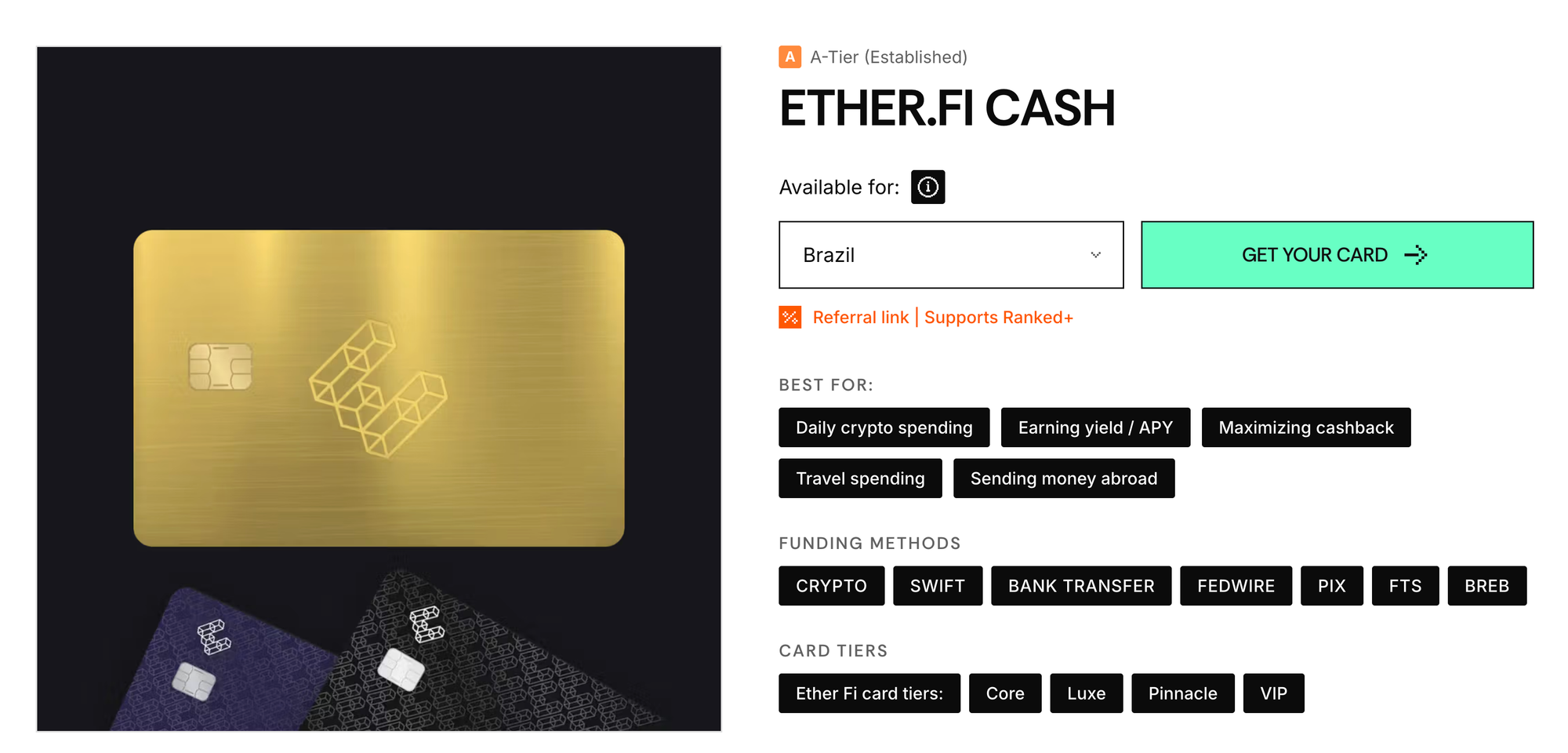
EtherFi Cash stands out in several parts of the dataset. It offers virtual and physical cards, is non-custodial, requires full KYC, supports funding via crypto, SWIFT, bank transfer, FedWire, PIX, FTS, and BREB, and shows 3% base cashback with APY up to 8%.
It also ranks well on both rewards and adoption. In our fee data it shows 0 minimum monthly fee, 0% FX fee, and 2% ATM withdrawal fee, with a note that some tiers may see 1% on other transactions. For Brazil specifically, the PIX funding line is one of its more important signals.
Gnosis Pay
Gnosis Pay is one of the cleaner low-fee options in our data. It is non-custodial, offers virtual and physical cards, requires full KYC, and supports funding via crypto, SWIFT, SEPA, and bank transfer. The dataset shows 1% base cashback, up to 5% APY, 0 minimum monthly fee, 0% FX fee, and 0% ATM withdrawal fee.
For a Brazil user, the appeal is straightforward: low explicit fees and a non-custodial structure. The main limitation is that it does not show PIX funding in our data, so the local operating flow may be less direct than some alternatives.
 Editorial team
RedotPay
RedotPay ranks high on adoption in our data and may appeal to users who want a more established user signal. It is custodial, requires full KYC, offers virtual and physical cards, and supports funding through crypto and bank transfer.
Its fee profile is less aggressive than the zero-FX group: 0 minimum monthly fee, 1% FX fee, and 2% ATM withdrawal fee, with 0% base cashback in our data. That makes it more of a scale and utility option than a rewards-first choice.
 Editorial team
Bitget Wallet Card
Bitget Wallet Card is the most eye-catching rewards entry in the Brazil dataset, with 10% base cashback and 20% max cashback listed in our ranking table. It is custodial, requires full KYC, and supports virtual and physical cards funded by crypto.
The main caution is simple: high promotional reward numbers need more scrutiny than low-fee cards do. In our core terms table, the card shows 0 minimum monthly fee, 1% FX fee, and 2% ATM withdrawal fee. For Brazil users, that means it may be worth checking for campaign conditions, caps, and practical spend economics before treating it as a routine card.
How to check card availability in Brazil using Ranked+ Cards
If you want to verify whether a crypto card works in Brazil before signing up, the fastest approach is to use Ranked+ Cards in two ways:
1. Use the Data section
Start in the Data section and filter for:
- Country: Brazil
- Status: Active or invite only
- Card type: Virtual, physical, or both
- Funding method: Crypto, bank transfer, or PIX
- Custody type: Custodial or non-custodial
- KYC level: Light or full
This gives you a narrower working list before you compare fees or rewards.
2. Check the card’s country breakdown
On each card profile, review the country or region availability details. This is where you should confirm:
- whether Brazil is supported;
- whether support applies to residents, not just usage geography;
- whether virtual and physical cards are both available;
- whether there are KYC or jurisdiction notes;
- whether the provider lists any country-level restrictions or in-app eligibility checks.
3. Read the restrictions note, not just the status
Some cards are listed as available but still have meaningful caveats. In our Brazil dataset, examples include:
- provider restrictions handled during KYC rather than in a public country list;
- mixed or unclear wording around signup geography versus card-usage geography;
- US-related exclusions that matter for some dual-residency or citizenship cases.
4. Compare the funding method with your actual workflow
For Brazil, this part matters more than it does in some other markets. If your normal flow is bank account to Pix to spend, then a card with PIX funding or simple bank transfer support may fit better than a card that expects repeated manual crypto top-ups.
Fees and restrictions Brazil users should check before applying
Even when a card is available in Brazil, the real decision usually comes down to a short list of checks:
| Check | Why it matters | What to look for |
|---|---|---|
| FX fee | Affects travel and foreign spend | 0% to 3% in our data |
| ATM fee | Matters for cash access | 0% to 3% |
| Funding rail | Changes usability | PIX, bank, crypto |
| KYC note | Can block signup | Full or light KYC |
A few patterns in our dataset are worth noting:
- 0% FX is available, but not universal.
- PIX funding appears on only some cards, which is important for Brazil.
- Full KYC is the norm for most shortlisted cards.
- Physical cards are common, but not every Brazil-available card ships one.
Which type of card may fit different users in Brazil?
For everyday domestic spending
A low-fee card with easy funding matters more than maximum rewards. In practice, users should compare the total spend flow against simply using Pix from a BRL balance.
For travel and online international purchases
Cards with 0% FX fee and 0% ATM fee may deserve the first look, especially COCA, Gnosis Pay, Revolut Crypto, and Wirex.
For stablecoin-first users
Users who keep balances in crypto and spend selectively may prefer KAST, MetaMask Card, Gnosis Pay, or EtherFi Cash.
For rewards-focused users
The main names to compare are Bitget Wallet Card, EtherFi Cash, Kolo, and Plasma One. The right question is whether the reward remains worthwhile after all limits and fees are considered.
Final take
The best crypto cards in Brazil are not all solving the same problem. Some are low-fee spend tools. Some are stablecoin bridges. Some are reward-heavy products with more conditions attached. And some look attractive globally but still need closer scrutiny for local usability.
For Brazil specifically, the strongest decision framework is simple:
- start with availability;
- check PIX or bank funding if local convenience matters;
- compare FX and ATM fees if the card is mainly for travel;
- treat cashback as secondary to clear operating costs;
- and confirm country restrictions during KYC before moving funds.
That is the practical way to compare a crypto card Brazil users can actually use, not just one that looks good in a headline.


